my electrical system
I built my DIY off-grid electrical system with zero experience or prior knowledge. From chaotic uncertainty to confidently living in my self-sustaining home on wheels, I learned to plan, problem-solve, and trust myself every step of the way. On this page, I’ll share how I designed, installed, and continue to maintain the system that powers my life on the road.

how I planned my off-grid system
Every system starts with a plan. That plan usually includes you know, a plan for the whole system... but my plan?
My plan was to take things oooone step at time, and to leave future me decisions to future me.
So I didn't actually have a whole plan.. but a plan of how the plan was going to come to be - chunked into three parts:
1. core components
2. power distribution components
3. the cable saga
Most people begin by mapping out their loads*, but those felt like future me decisions I wasn’t ready to make yet.
Instead, I focused on understanding the core components first.
For one month straight, it felt like all I did was research, look up definitions of a million words, blankly stare at electrical diagram, watch youtube videos and take a bunch of notes... and that was just to (semi) confidently make decisions on the core components!
But eventually, I made up my mind. ⬇️
1. battery bank aka "house batteries"
-
stores the energy to be used for DC* loads
-
connected to my van starter battery
2. solar panels
-
collects energy from the sun
3. inverter charger
-
inverts DC to AC* to power AC loads
-
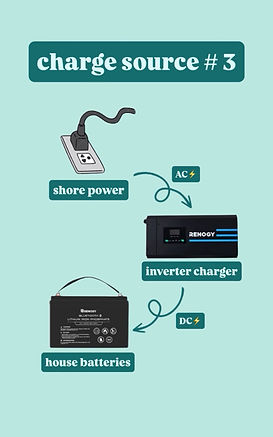
connects to shore power* to charge batteries
4. MPPT charge controller
-
regulates and distributes power input and output
-
allows for three charge sources*⬇️
core components of my system:


🔎 key
terms
*If you get a little lost along the way, don't worry - I did too. Here are a few key terms for ya.
loads - things that consumer power (lights, fan, heater, water pump, charging devices)
DC power - direct current, the kind of power typically stored in batteries
AC power - alternation current, the kind of power household outlets use
shore power - the ability to connect to an external AC power source to charge batteries
charge source - way of getting power to the house batteries
what I considered before
buying the core components:
-
size & weight - space and weight are key in a van, so every component had to earn its place
-
operating & storage temperatures - the system needed to perform reliably in both heat and cold
-
input & output voltage ranges — these ranges impacted how the system could be connected (series vs. parallel*)
-
charge & discharge limits — staying within safe current limits protects both the batteries, and the system as a whole long term
-
capacity limits — understanding how much power each part, and the system as a whole could realistically handle
-
system compatibility — each component needed to communicate and work together a cohesive system (why I went with a Renogy setup)
-
expandability — I wanted the flexibility to add more capacity later if needed, so the limits had to allow for an additional battery or solar panel
-
safety & protection features — built-in protections like over-current* and temperature safeguards were non-negotiable
-
efficiency — higher efficiency meant less energy lost and more usable power
-
monitoring & feedback — being able to connect via bluetooth to see what the system is doing makes monitoring and troubleshooting much easier
for the detail oriented folks...
a deeper dive ⬇️
curious how these considerations shaped my actual system? ready for a deeper dive into the specs?
swipe through the gallery to see the specs I actually took note of for each of the core components of my system.

These panels collect energy from the sun to charge the batteries. Specs like voltage, amperage, and efficiency helped me make sure they matched the charge controller, my energy needs, and connect them correctly.

Regulates DC power from the solar panels to the batteries. Specs like maximum input/output current and efficiency ensured the system stayed safe and charged optimally.

My house batteries store the energy that powers the van. I chose these based on capacity, charge/discharge limits, and expandability so I could rely on them day and night without surprises.
These panels collect energy from the sun to charge the batteries. Specs like voltage, amperage, and efficiency helped me make sure they matched the charge controller, my energy needs, and connect them correctly.
power distribution components:
how power moves through my van
Once the power is generated, stored, and converted, the real question becomes: "how does it safely get where it needs to go?”
Power distribution is the part of the electrical system that determines whether everything feels calm and predictable — or straight up dangerous.
When considering how both AC and DC power moves through my off-grid electrical system, we're really talking about components that have to do with safety & protection, distribution, and isolation & troubleshooting⬇️:
These components keep my system, circuits, and devices safe from overloads* and shorts*.
1. fuse block
-
all DC circuits run though my fuse block
-
makes it easier to have one hub instead of running a
bunch of in-line fuses*
2. AC distribution center
-
all AC circuits run through my distribution center
-
protects each AC circuit with breakers* — if one trips, the
others keep running
3. different kinds of fuses
-
protects individual circuits at varying amperages*
-
ANL fuses — for battery > inverter connections
-
Fuse block fuses — for fuse block > load connections
-
MC4 fuses — for solar panels > charge controller connections
-
Breakers — for AC load connections, resettable protection
-
safety & protection:


distribution:
These components organize and route the power efficiently.
1. bus bars (positive and negative)
-
minimizes connection points and keep wiring tidy
-
positive — distributes power from the battery’s positive terminal
-
negative — provides a central return path to complete circuits
-
2. outlets (120v and 12v)
-
provides convenient access to AC and DC power
-
USB charging ports (DC)
-
cigarette lighter style ports (DC)
-
regular household outlets (AC)
-


isolation & troubleshooting:
These components and practices make it possible to safely identify, isolate, and fix issues without shutting down the entire system.
1. switches
-
allows me to isolate specific circuits or the entire system
-
easier to troubleshoot a problem without affecting other circuits
-
helps prevent accidental overloads or shorts while troubleshooting

Beyond the individual components, I planned the system so every circuit is labeled and every connection point is accessible. That way, if something doesn’t behave as expected, I can trace it, isolate it, and fix it quickly — without shutting down the whole system or guessing where the problem is.
It’s not just about hardware; it’s about creating a system I can trust.